
Christ Was Not a Jew Book Review: Examining Jacob Elon Conner’s Controversial Claims
Introduction
Jacob Elon Conner’s Christ Was Not a Jew: An Epistle to the Gentiles (1936) is a controversial and polemical work that challenges the traditional understanding of Christianity’s origins. In this book, Conner argues that Jesus was not Jewish and that Christianity should be viewed as a fundamentally Gentile religion.
Because of its bold claims and historical assertions, the book continues to provoke debate among readers. This review examines Conner’s central arguments, his use of scripture, and how his conclusions compare with mainstream Christian scholarship.
The Core Thesis: A Gentile Galilee
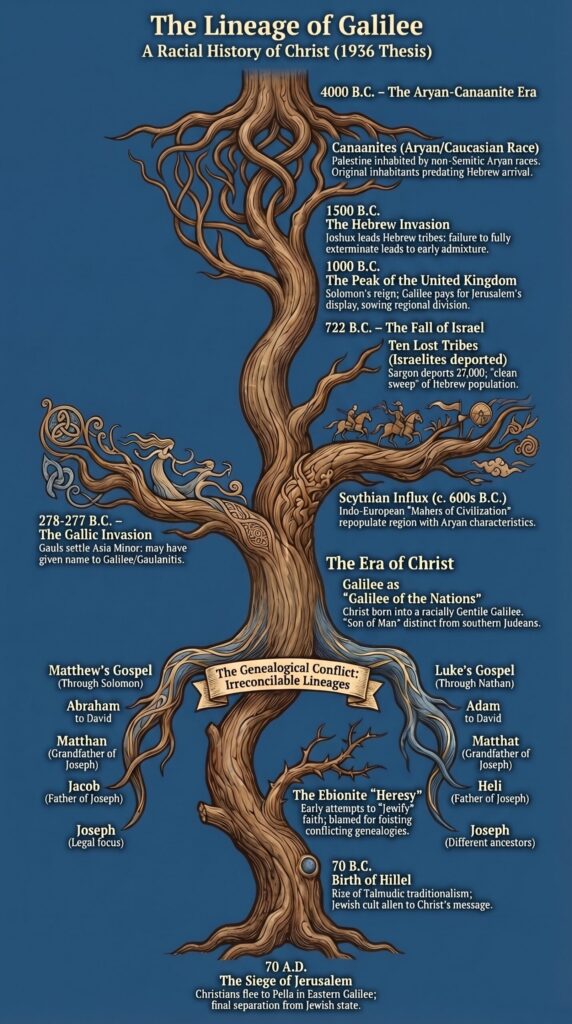
The main argument of Conner’s work is that Jesus was a Galilean and that Galilee was predominantly Gentile in composition prior to the time of Christ. According to the author, this distinction separates Jesus from Jewish identity and reframes Christianity as a non-Jewish faith. The central argument of the book is historical and racial rather than doctrinal. Conner asserts that “Christ was a Galilean”, and that Galilee was racially Gentile long before the time of Christ. He provides a timeline of “purges” to support this argument:
The Assyrian Conquest (722 B.C.): Sargon removed the ten tribes of Israel and replaced them with Aryan and Semitic Gentiles, making the region “Galilee of the Nations”.
The Maccabean Period (164 B.C.): Simon Maccabee removed the remaining Jewish infiltration from Galilee back to Judea, leaving the region strictly non-Jewish again.
Conner points to the Assyrian conquest and the Maccabean period as key moments when Jewish populations were allegedly removed from Galilee and replaced by other groups. He identifies the inhabitants of Galilee as a mixture of Aryan/Caucasian stocks, including Canaanites (whom he identifies as Aryan), Scythians, Gauls, and specifically Greeks, who permeated the region through the Decapolis. He uses the writings of Josephus, to argue that Galileans were temperamentally and ideally distinct from Judeans, noting a “taboo against intermarriage” between the two groups.
Historical Claims and Supporting Evidence
Conner identifies several groups as inhabitants of Galilee, including Greeks and other non-Jewish populations. He also references historical sources such as Josephus to argue that Galileans were culturally and socially distinct from Judeans.
These claims are used to support the broader conclusion that Galilee was not a Jewish region at the time of Christ. However, these interpretations are debated and not widely accepted among modern historians.
Critique of Gospel Genealogies
A substantial portion of the book focuses on refuting the relevance of the “Jewish messiah tradition” to Gentile audiences. Conner criticizes the genealogies presented in the Gospels of Matthew and Luke, describing them as “totally irreconcilable”. He argues that these records were imposed upon the New Testament by the “Ebionites” (Judeo-Christians), who aimed to confine Christ’s mission to a claim regarding the “throne of David”—a claim that Conner asserts was ridiculed by Christ himself. He claims that Jesus presented a message that was not tied to national or ethnic identity.
He argues that Christ purposely detached himself from Judaism by:
– Appealing to God as the Father in Heaven rather than the “Hebrew racial deity Jahveh”.
– Referring to Jews objectively (“whither the Jews always resort”) rather than as his own people.
– Declaring that his kingdom was “not of this world,” thereby repudiating the Jewish expectation of a political, military messiah.
Interpretation of Scripture
Conner makes extensive use of both Old and New Testament passages to support his argument. He highlights scriptures that describe Israel’s disobedience and uses them to question its theological role.
At the same time, critics of Conner’s work note that his interpretation of scripture is selective and does not reflect the broader consensus of biblical scholarship. Many theologians emphasize the continuity between Judaism and Christianity rather than a complete separation.
Readers who wish to examine these passages in context can
read the full biblical texts here.
The Polemic against Judaism
The book shifts from historical research to a harsh criticism of Judaism, which Conner characterizes as a “parasitic racial cult” as opposed to a global religion. He makes extensive use of interpretations of the Talmud, which he describes as a code of “private warfare” and “Satanism” against Gentiles.
According to Conner, Judaism is fundamentally anti-national. He points to the 1917 “attack of Jewish bolshevism upon Christian Russia” as an example of how the same “morals and methods” that were employed against Rome 2,000 years ago are still in use today. He comes to the conclusion that because Jews are primarily committed to an organized racial tribe that aims to “defile and then destroy” the host state, they can never really be considered citizens of the United States.
Tone and Methodology
The tone of Christ Was Not a Jew is assertive and confrontational. Conner presents his conclusions with confidence and often dismisses opposing viewpoints. He dismisses those who say Christ’s race is irrelevant as being guilty of “intellectual indolence”. He utilizes a variety of secular historians, including Tacitus, Pliny, Gibbon, and Renan, to provide a “Gentile perspective” that he claims is free from the influence of Hebrew traditionalism.
He draws on a range of historical sources, including classical historians, to support his claims.
Historical “Purges” of the Jewish Population
Conner asserts that Galilee was systematically cleared of its Jewish inhabitants twice before the time of Christ:
The Assyrian Conquest (722 B.C.): King Sargon removed the ten tribes of Israel and replaced them with people from Babylon, Cutha, Ava, Havath, and Sepharvaim. The author claims these replacements were of both Aryan and Semitic stock, but included none of “the chosen race”.
The Maccabean Period (164 B.C.): Simon Maccabee removed the remaining “Jewish infiltration” from Galilee back to Judea, leaving the region “strictly non-Jewish again”.
Modern Scholarly Perspective
Modern historians and biblical scholars generally affirm that Jesus was Jewish and that Christianity emerged within a Jewish cultural and religious context. This position is supported by a wide range of historical and textual evidence.
As a result, Conner’s arguments are typically viewed as controversial and outside mainstream academic consensus. Nevertheless, the book remains a subject of interest for those exploring alternative interpretations of early Christian history.
For related discussions on theology and modern figures, see
Is Franklin Graham a Zionist?
and
Franklin Graham’s background and beliefs.
Conclusion
Christ Was Not a Jew is a provocative work that challenges traditional views of Christianity’s origins. The book concludes that Christianity belongs to the Gentile world because its founder was the “Son of Man” (a Gentile designation in Conner’s view) rather than a Jew. It serves as a call to arms for Gentiles to “scrap Judaism” and its “demoralizing influence” to preserve the purity of the Christian faith. While Jacob Elon Conner presents a detailed argument based on historical and scriptural interpretation, his conclusions remain highly contested.
Readers approaching this book should do so with a critical perspective, comparing its claims with established scholarship and a broader reading of scripture. As with any historical or theological work, careful examination is essential in forming a well-informed view.